You are here: Home » 2009.12

Bibliolepsy (1997)
Bibliolepsy, Gina Apostol’s first novel, is also the first Filipino novel I’ve read that is openly in love with words and made it its thematic and narrative trope. The narrator is Primi Peregrino, who at age 4 would go over the twenty-volume set of the Oxford English Dictionary with her older sister Anna.

Dugo sa Disyerto (1990-1992)
Nobelang komiks ni Mario S. Cabling ang Dugo sa Disyerto at iginuhit niha F. C. Javinal at Rey H. Samson. Naiserye ito sa Liwayway sa loob ng 113 na isyu simula noong Oktubre 8, 1990 hanggang Disyembre 7, 1992.
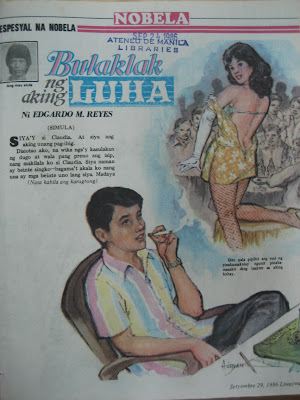
Bulaklak ng Aking Luha (1986-1987)
Nobela ni Edgardo M. Reyes na lumabas sa loob ng 30 isyu sa Liwayway mula Setyembre 29, 1986 hanggang Abril 20, 1987 ang Bulaklak ng Aking Luha. Inilathala rin ito bilang isang aklat ng RB Filbooks noong 1988.

Devi-Liza (1989-1993)
Nobelang komiks ni Rex Guerrero at iginuhit ni Karl Comendador at RV Villanueva ang Devi-Liza. Naiserye ito sa Liwayway mula Oktubre 2, 1989 hanggang Pebrero 1, 1993 sa loob ng 174 na labas.
Powered by Wordpress and Wpcrunchy
Design by Acai Berry. Converted to Blogger Templates By wp2b